
The Long View: Proof of Concept
- Jason Longshore

- 4 days ago
- 8 min read
Atlanta United has been building toward a goal like Tristan Muyumba's all season. On a cold afternoon in Toronto, without their captain and with a disallowed goal already behind them, they built it anyway.
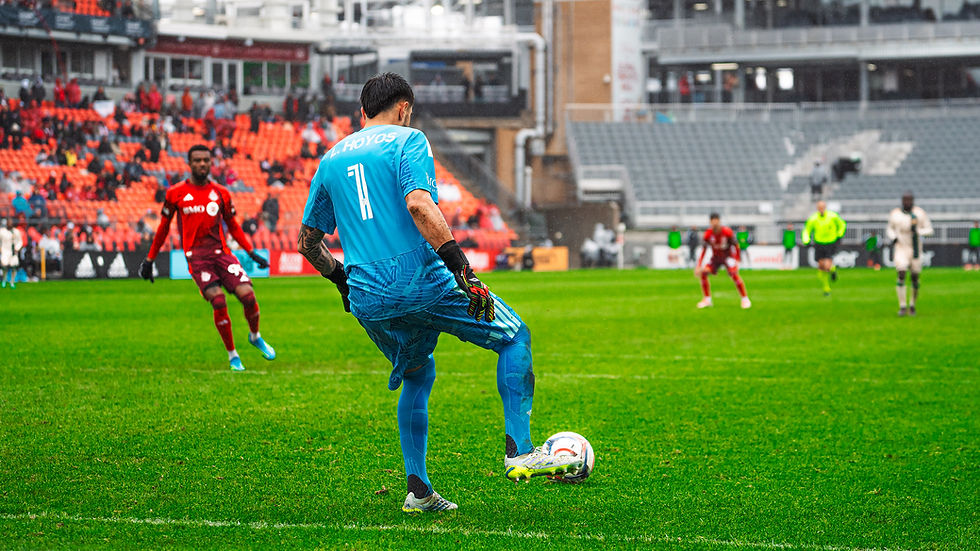
There is a version of what happened at BMO Field on Saturday afternoon that fits comfortably into the familiar Atlanta United story. The xG finished essentially even, 0.97 to 0.98. Total shots were modest on both sides. The margin was a single goal, and it came late enough that the final stretch felt precarious. By the raw numbers, this could be read as a fortunate win for a team that has spent most of 2026 finding ways to lose matches it should have taken.
That reading would miss almost everything that actually mattered.

Atlanta United did not win in Toronto because the game broke the right way. They won because a specific thing that has been failing all season finally worked: midfielders arriving into the penalty area at the right moment, in combination, when it counted. That mechanism is not random. It has been visible in flashes since the 3-1 win over Philadelphia in March, then more clearly in the first half against Chattanooga in the US Open Cup, and now on a cold, messy afternoon in Toronto with Alexey Miranchuk wearing the armband for a suspended Miguel Almirón. Three results. Three data points. One accumulating argument.
Tata Martino has been calling every match the game where things change. On Saturday in Toronto, it finally was.
What Togashi Built Before He Left
The piece of this match that the numbers cannot fully capture is the thirty minutes Cayman Togashi spent on the field before the afternoon turned against him twice in quick succession. A goal he scored was overturned by VAR after review. Then, on that same play, Togashi turned his ankle badly enough that he could not continue. He was gone before halftime, taking with him the specific movement that had been making Atlanta dangerous.
I had mentioned before his injury that Togashi's movement was doing something specific to Toronto's defensive shape. Their high line was vulnerable to a center forward who pulled them apart with movement, and Togashi was finding those moments repeatedly. The template was clear: Atlanta's structure was working, and the particular thing it was doing well was getting numbers into dangerous areas because of how Togashi's runs pulled defenders out of position.
When Togashi's goal was taken away and he then had to come off with the ankle injury, my reaction on the broadcast was not primarily about the refereeing. After finally seeing it from a better angle at halftime, the offside call recommended by VAR was the right one. What I was thinking about was the question his absence immediately raised: could Atlanta replicate the same off-ball movement with different personnel? Could the template survive losing the player who had most clearly been executing it?
The answer came in the 67th minute, and it came from exactly the kind of player Martino had been describing all week.
The Goal That Proved the Concept
The second goal did not look like an accident. It looked like a training ground sequence that had been waiting for the right moment.

Cooper Sanchez, 18 years old and increasingly one of the most important players in this Atlanta midfield, played a pass to Fafà Picault, who had come on as a substitute eight minutes earlier. Picault found Tristan Muyumba arriving into the penalty area, and Muyumba finished with his left foot from close range.
Martino described the anatomy of it afterward precisely. "The second goal is a very good pass from Cooper to Fafà, who leaves Tristan one-on-one. But in the development of the play it is an association that brings together Tristan with Jay and with Cooper." He then said something that told you more about where this team is than any single result: "I think there is still a lot to grow there."
Miranchuk's description of the same goal was even more tactically explicit.
"It came from the short passes, the movement. That's what we wanted, and that's what we did. We want the eights to go inside the box and be dangerous, and that's what happened."
The eights going inside the box. That phrase matters. Expected Goals, the metric that estimates how likely a shot is to result in a goal based on its location and circumstances, told us all season that Atlanta was generating chances at a level that should have produced more goals. The arrival problem, as this column named it after the Chicago match, was one reason the xG was not converting: midfielders were not reaching the penalty area in time and in numbers to make Atlanta's possession dangerous. On Saturday, Muyumba was in exactly the right place at exactly the right moment. That is the arrival problem solved, at least once, in a match that needed it solved.
The pass accuracy in the final third tells the same story from a different angle. Atlanta completed 76.1% of their passes in the final third. Toronto managed 57.1%. In a match where possession was essentially even, that gap in final-third efficiency is the entire explanation for why two goals came from six shots while nine shots produced only one.
Miranchuk, Armband and All
The first goal came from a free kick, and the story around it is worth telling fully.
Ajani Fortune won the foul that produced the opportunity. Then Miranchuk stepped up to take it.
He described what happened after the match with the kind of specific detail that only comes from a player who had genuinely thought through the execution. "Tris (Muyumba) and Juan (Berrocal) asked me: are you sure? I was like: of course I'm sure. And when I scored, Lukey ran to me and said: I knew you were going to score."
The delivery matched the confidence. "It was a pretty close free kick, so it's not so easy because you cannot use your power. You need to put it in a perfect spot." The ball went exactly where he said he would put it. Miranchuk now has five goals in nine appearances this season, against an expected goals figure of 2.86. He is consistently outperforming expectation by a margin that reflects genuine quality rather than statistical noise.

Later, with Atlanta protecting the lead, Miranchuk made a defensive play on Josh Sargent near the top of the penalty area that, as I noted on the broadcast, he really had no business making from an attacking player's positional standpoint. He was there, he made it, and it held. That kind of contribution, a captain doing the unglamorous work when the moment demanded it, was what Martino was describing when he assessed the performance afterward.
Martino's framing was telling in its deliberate evenhandedness.
"This is always what we expect from our best players. For me, he had already done very well in the previous match despite the defeat. And of course, this is always what we expect from Miguel when we can have him. I have no doubt that both of them are fully capable of leading us in a soccer sense."
Two leaders. Two expectations. One showing up every week, one on his way back. That arithmetic will matter for the rest of the season."
The Youth Cohort Is Not a Talking Point
Every voice in the postgame said the same thing about the same group of players, and when that happens across a manager, a captain, and a right back who just played what this broadcaster called his best professional game, it is worth paying attention to.

Martino gave all of them praise: Matt Edwards. Cooper Sanchez. Luke Brennan. Ajani Fortune. Will Reilly. "That gives us a lot of excitement for the future," he said, and it did not sound like boilerplate. It sounded like a coach describing the part of his roster that is actually giving him answers right now.
Edwards himself said something after the match that connected directly to what the data showed about how Atlanta won this game. "We finished our chances that we got." Not: we created more. Not: we dominated the match. We finished what we had. That is the clinical efficiency argument in the plainest possible language from the player who spent 84 minutes on the right side doing things the stat sheet could not capture. The passing network shows his connection with Miranchuk was one of Atlanta's most prominent, which aligns with what I was watching on the broadcast: Edwards pushing high, holding his position, giving Miranchuk an outlet and a combination partner on that right side consistently through the match.
The passing network data shows something else worth naming. Atlanta's vertical compactness was 66.83% compared to Toronto's 73.1%. Vertical compactness measures how stretched a team's shape is from back to front when they have the ball. The higher the number, the more a team's passing is happening in a compressed, horizontal band. The lower the number, the more the team is moving the ball with range and getting players into advanced positions. Atlanta's lower figure is evidence of the midfield arrivals that Miranchuk described. This was not a team circling possession in front of Toronto's defense. It was a team that moved the ball with vertical intention.
Holding What They Had
The final twenty minutes were not comfortable. Toronto's goal in the 71st minute came from Emilio Aristizábal, who took four shots in this match and generated the most individual xG of any Toronto player at 0.29. Atlanta had to defend a sustained push in the closing stages, and Edwards was direct about what that required.
"We let it slip again against New England, and we learned from that moment as a group, and we used it for today. Our mentality, each one of us defensively, we all stuck in to get the result."
Miranchuk reinforced it from the attacking player's perspective.
"From my perspective as an attacking player, you see all the defenders doing their jobs very well and fighting to win the balls. It gives me energy."
That loop, defensive effort generating attacking confidence, is what a functional team looks like. It has not always been visible this season. It was visible on Saturday.
Three Points of Proof
Matías Galarza said it in the Training Ground Notebook before the Nashville match, and the belief behind it never wavered even when the results did: the buildup is there, the structure is there, the goals just have not been going in. Philadelphia gave that belief its first real foundation. Atlanta survived a physical, confrontational game that was exactly what the Union wanted, then made its moments count when it mattered. The losses that followed did not erase what Philadelphia showed. They just left it unconfirmed.
Chattanooga offered the next glimpse. A lower-division opponent in the US Open Cup is not the same test, and Tata was careful to say so afterward. But the first half against Chattanooga was the clearest extended look at the attacking combination Atlanta had been working toward, with numbers arriving in the box and the pieces connecting the way the coaching staff had been describing in training. The belief that this could work was real. The evidence that it would work consistently was still incomplete.
Toronto completed something. Not everything, but something specific and important. A road win, without Almirón, against a tough opponent, in difficult conditions, with a disallowed goal and an injury already in the books before the decisive action. The midfield arrived. The captain delivered. The substitutes contributed. The team held what it had when holding got hard.
Martino has been telling his players for weeks that each match was going to be the one where things change. His players heard it so many times it had become almost ambient. Saturday was the match where it was finally true, and he said so plainly:
"We have been telling the players for various matches now that this is going to be the game where things change, and we turn the rhythm around. And finally today, that was the case."
Three points in the standings. Three points of proof.
The concept works. Now Atlanta has to prove it wasn't a coincidence.


Comments